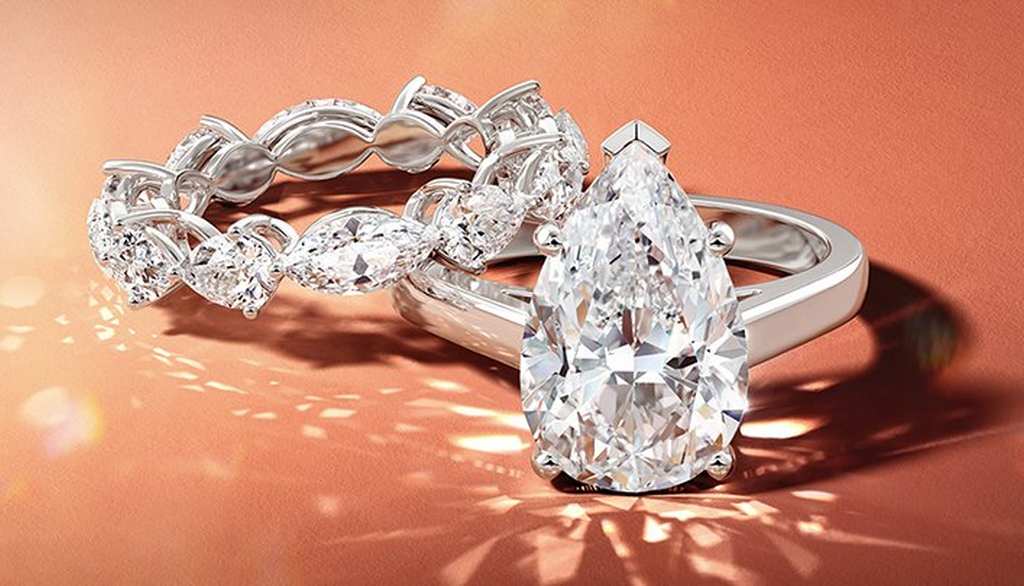

Emerald-cut diamonds belong firmly in the second category. Their long, clean lines and broad facets produce flashes of light rather than the rapid scintillation associated with round brilliant stones. That visual restraint gives the design an architectural quality—polished, confident, and particularly suited to someone who prefers elegance without excess.
Interest in emerald engagement rings in Singapore reflects a wider shift toward rings that feel distinctive without depending on elaborate decoration. The emerald shape can look striking as a solitaire, refined with side stones, or highly contemporary in a bezel setting. Yet its beauty depends on choosing proportions, clarity, setting style, and metal with care.
What Makes an Emerald-Cut Diamond Visually Different?
An emerald-cut diamond uses a step-cut faceting pattern. Instead of many small triangular and kite-shaped facets, it has long parallel facets arranged around a large open table.
This creates the characteristic “hall of mirrors” effect: broad flashes of light separated by darker geometric reflections.
That structure changes how the diamond should be judged.
With brilliant cuts, intense sparkle can sometimes make small inclusions harder to notice. An emerald cut is less forgiving because its open facets allow a clearer view into the stone. Clarity therefore deserves close attention, particularly for inclusions located beneath the table.
Cut quality also goes beyond a simple label. Buyers should examine:
- symmetry and even facet alignment
- length-to-width ratio
- corner proportions
- depth and table percentages
- light and dark contrast across the diamond
- whether the stone appears lively rather than flat
Two emerald-cut diamonds with similar certificates can still look noticeably different when viewed side by side.
Proportion Shapes the Personality of the Ring
Emerald-cut diamonds are rectangular, but not every rectangle creates the same impression.
A longer stone can make the finger appear visually elongated and often feels more dramatic. A slightly broader emerald cut has a softer presence and can appear substantial from the top.
There is no universal ratio that suits everyone. Personal preference, finger shape, carat weight, and setting design all affect the final result.
| Design Detail | Visual Effect | May Suit Buyers Who Prefer |
|---|---|---|
| Elongated emerald cut | Sleek, graceful appearance | Modern or minimalist jewelry |
| Broader emerald cut | Stronger face-up presence | Classic proportions |
| Solitaire setting | Clean focus on centre stone | Understated elegance |
| Side-stone setting | Added width and brilliance | More decorative designs |
| Bezel setting | Defined geometric outline | Contemporary styling |
| Hidden halo | Discreet sparkle from side view | Detail without a busy top view |
A jeweler should ideally show the stone from several angles rather than relying only on carat weight or certificate specifications.
The Setting Can Change the Entire Character
Emerald-cut diamonds are remarkably sensitive to setting design.
A four-prong solitaire keeps the outline visible and allows light to enter freely. Claw-style prongs can make the design feel delicate, though secure workmanship remains essential because the cropped corners need appropriate protection.
A bezel surrounds the stone with metal and emphasizes its geometry. It can also provide a reassuring level of edge protection for people who wear their ring throughout an active working day.
Three-stone arrangements introduce a more traditional jewelry language. Tapered baguettes work particularly well because their linear faceting complements the centre diamond rather than competing with it.
Pavé shoulders create stronger contrast: the small brilliant-cut diamonds sparkle rapidly beside the calmer flashes of the emerald centre stone.
A hidden halo offers another approach. From above, the ring can remain relatively restrained; viewed from the side, a row of smaller diamonds adds detail beneath the main stone.
Metal Choice Is More Than a Colour Decision
The metal surrounding an emerald diamond changes how its crisp outline is perceived.
Platinum offers a naturally white appearance and is widely used for fine jewelry where strength and stone security matter. White gold creates a similarly cool visual effect, although its appearance and maintenance depend partly on alloy composition and surface treatment.
Yellow gold creates stronger contrast against a colourless or near-colourless centre stone. It can make an angular emerald cut feel warmer and slightly more vintage-inspired.
Rose gold brings a softer tone, especially when paired with a slim band. Some buyers also combine a warmer band with white-metal prongs so the diamond’s visible colour is influenced less by its immediate setting.
Practicality matters in Singapore’s warm, humid climate as well. A comfortable band profile, secure construction, and sensible cleaning routine can matter more over years of wear than an intricate design that looks impressive only in photographs.
Clarity, Colour and Carat Need to Be Balanced
Carat weight receives plenty of attention, but it should not dominate the decision.
Because emerald-cut diamonds can show inclusions more readily, an eye-clean appearance is usually more meaningful than chasing size alone. Clarity grades provide useful guidance, but inclusion type and placement matter. A small inclusion near an edge may be less noticeable than one directly beneath the centre of the table.
Colour is also easier to perceive in some step-cut stones because of the large facets. Buyers choosing white platinum or white gold may place greater emphasis on a higher colour grade, while warmer metals can sometimes make slightly lower colour grades visually appealing.
This is also where lab-grown options broaden the design conversation. Buyers researching lab created diamonds can compare larger centre stones, different clarity combinations, and platinum settings while still evaluating the same core grading characteristics used to assess diamond appearance.
The important point is not simply choosing the highest specification. It is finding the combination that looks balanced in the actual ring.
Certification Should Support, Not Replace, Visual Inspection
A diamond grading report provides structured information about characteristics such as carat weight, colour, clarity, measurements, and other identifying details.
That documentation is valuable when comparing lab-grown diamonds, especially during online jewelry purchasing. Yet certification cannot tell you exactly how attractive an emerald-cut diamond will appear on the hand.
Ask to see clear videos or high-resolution imagery when shopping remotely. Look for even contrast, pleasing proportions, visible inclusions, window-like areas, and any obvious asymmetry.
Resources such as Novita Diamonds can also be useful when researching how lab-grown centre stones pair with platinum engagement ring designs and different setting styles.
The most informed purchase combines documented grading information with careful visual assessment.
Think About the Wedding Band Before Finalising the Setting
The engagement ring does not exist in isolation for long.
An emerald-cut solitaire with a high enough gallery may allow a straight wedding band to sit closely beside it. Lower settings can create a small gap, which some wearers enjoy and others prefer to avoid.
Pavé bands can increase brilliance, while plain platinum or gold bands keep the emerald-cut centre stone visually dominant. A curved or contoured wedding band may work better with certain halos, bezels, or low-profile settings.
Custom engagement rings give buyers more control over these proportions. Band width, setting height, prong shape, gallery design, and wedding-band clearance can all be considered together rather than treated as separate decisions.
For emerald engagement rings in Singapore, this kind of planning often produces a more satisfying result than focusing on diamond size alone. The strongest design is one in which the stone, setting, metal, certification, comfort, and future wedding band all feel intentionally connected.